
News
29.01. - 07.03.2026 PAULIS LIEPA "Trading"
29.01. - 07.03.2026
Galerija "Māksla XO"
Elizabetes iela 14, Rīga, LV 1010
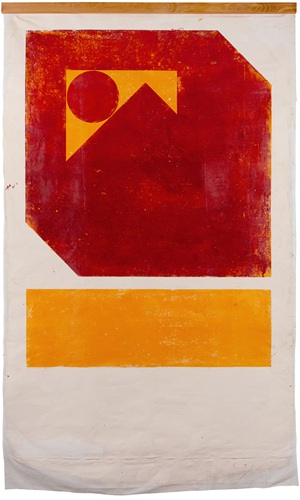
Trading
“Trading, wrangling and bargaining – bartering wool for clamour, land for a seat in the front row, or for the larger slice of the pie. A struggle for position in the news feed and for more favourable interest rates.
Flags – ragged edges, one’s own and foreign colours, primitive forms and broad areas of colour. Counting the spoils before they are secured and dividing into camps.Territories, spheres of influence, arrows and marks of recognition.
The works are created using a relief printing technique, employing cardboard clichés and alkyd enamel, without the use of a printing press or other tools. Radical simplicity, a laconic colour palette, and a deliberate avoidance of the technical complexities characteristic of printmaking result in the use of primitive forms, large areas of colour, and coarse textures. When printed on fabric, the works acquire a flag-like form, which constitutes a conceptually significant component of the exhibition’s underlying idea” – Paulis Liepa, January 2026.
Paulis Liepa is one of those artists who, over the years, does not do exactly the same thing, yet in any case works with a very distinctive style. Casting an eye over any work in the exhibition, it is immediately clear that it is Liepa, and then one must delve deeper and try to dig up what Paulis Liepa has buried there. If he is pressed to talk about his works, it becomes apparent that in each of them there is something more than merely something beautiful, formally and graphically interesting. What appears to be a landscape may, in fact, turn out to be a years-long sociological study of population size, or something entirely different. (Krišs Salmanis, 2019.)
When looking at Paulis Liepa’s works, there is a feeling as if you enter a space and do not quite understand what it all means. You may try to understand it, yet never fully do so, but there is something very tactile about it all, something that makes you want to scratch, to touch, to try to realize. (Anna Salmane, 2019.)
Paulis Liepa is one of the most internationally recognised Latvian contemporary printmakers. Working with the simplest and most primitive printmaking techniques, such as cardboard cut and collography, with or without a press, and employing vivid, “worn” colours, he has developed a distinctive author’s technique unique to himself. In his works, Paulis Liepa uses specific, carefully encoded visual codes, drawing inspiration from contemporary and current issues – philosophical, global social, ecological, and, particularly in recent years, political and geopolitical.
Paulis Liepa (1978) graduated from the Department of Graphics at the Art Academy of Latvia in 2003 and has been a lecturer there since 2016. His works and solo exhibitions have been nominated for the prestigious Purvītis Prize multiple times. He has received numerous international awards. In 2023, he was awarded the main prize at the international contemporary art fair ArtVilnius’23 in Lithuania, receiving the title of Best Artist.
Works by Paulis Liepa are held in public collections, including the Latvian National Museum of Art (Riga, Latvia); the Latvian Museum of Contemporary Art collection (Riga, Latvia); the Zuzāns Collection, ZUZEUM Art Museum (Riga, Latvia); the Art Collection of the Bank of Latvia (Riga, Latvia); the Swedbank Contemporary Art Collection (Riga, Latvia); the VV Foundation Collection (Riga, Latvia); the Deutsche Telekom Art Collection (Berlin, Germany); the KAI10 | Arthena Foundation (Düsseldorf, Germany); the Simmons Contemporary Art Collection (London, United Kingdom); the Maria Larsson Art Collection (Zurich, Switzerland); the YUANART Collection (Lucerne, Switzerland); and the Kaliningrad State Art Gallery (Kaliningrad, Russia). His works are also held in private collections in Latvia and abroad, including - the Gilles Fuchs Private Collection (Paris, France); the Beatrix Millies Private Collection (Berlin, Germany); the Zdenek Felix Private Collection (Munich, Germany); the Ursula Krinzinger Private Collection (Vienna, Austria), the Christian Kaspar Schwarm Private Collection / SCHWARM PROJECTS (Berlin, Germany).